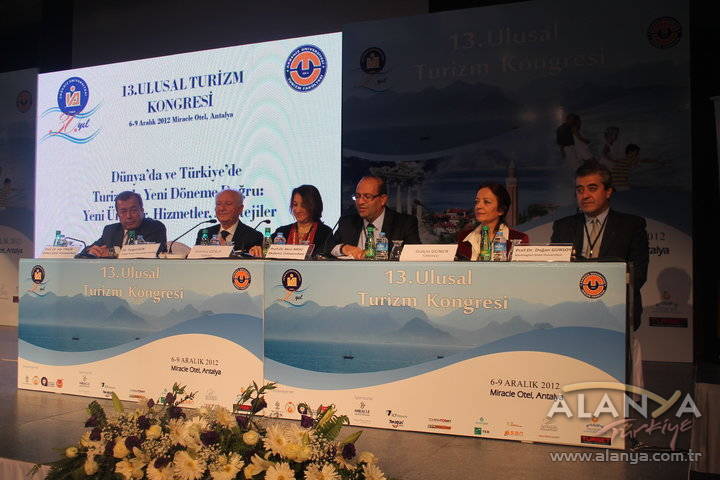
Akın Aksu stated that one in every 12 people in the world is related to tourism, saying, “The tourist profile is changing; a consumer who organizes their own individual visits, travels more but stays for shorter durations, and utilizes information technologies. Social media usage is very widespread. In one month, there are 700 billion minutes and 30 billion pieces of content on social media. Half of those traveling from Europe will turn to smartphones for information and reservations.”
Pointing out that since 3.19 million people have arrived in our country as of the end of 2012, there is a tourism revenue expectation of 23.5 billion dollars, Aksu spoke, saying, “When we look at the strategies of our competitors, we ask ourselves if we are truly on the threshold of a new era. Will there be changes in our products, services, and strategies, and will there be new markets? Should we discuss new travel packages?”
In her speech during the session, TÜRSAB Secretary General Günnur Özalp said, “Antalya's development was far ahead of Turkey's development. If we carry the quality in our hotels to our cities, we will catch up with modernity. Tourism no longer belongs only to our ministry, our governor, our mayor, or a few non-governmental organizations. As a whole, our business is being recognized by the Ministry of Economy as a service sector, and they are providing incentives. There are also supports from the Ministry of Development. There is a new phenomenon called health tourism. It is no longer enough to just say 'let business tourists come'; it needs to be looked at holistically. Economies have contracted, but travels have increased and durations have shortened. We need to adapt ourselves to this. Antalya needs to be a cruise gateway in the Eastern Mediterranean. It needs to surpass Istanbul, Izmir, Kuşadası, and Marmaris. Large cruise ships must definitely have Antalya as a stop. This is what will elevate Antalya. The arriving customer will become a new customer.”
ALTİD President Gülçin GÜNER addressed the importance of integrating practice with science and the importance of the workforce:
“In the regions, we can discuss our costs both with the political will and by coming together with the sector. We can foresee anticipated crises in advance and take precautions. While five important centers used to hold 75 percent of the weight in the sector, this rate has now dropped to the forties. With the facilitation of air transportation, it rose to the forties. Antalya is still a dynamic force and catalyst; there is great development in investments in Istanbul and Anatolia. Foreign groups' expansion policies involve their sub-brands investing alongside their main brands. We also see that domestic investors' understanding of growth on the coast is shifting toward city hotel management and boutique concepts, and domestic groups are moving toward diversifying their own brands. This is also a pleasing development. Family and wellness hotels, and hotels catering to adults, are developing as sub-brands even in domestic chain hotels. There are also investments in thermal tourism and winter sports. Shopping tourism research has determined that one-third of those coming from European countries and China allocate time to shopping. We also have our Turkish cuisine, which we are trying to develop during a difficult process in gastronomy tourism. The world and Europe are progressing rapidly in this regard. Shopping festivals also exist in the Middle East. The subject of cinema is creating a revival in African countries. It creates tourist traffic, and brands are starting to arrive. In Asian countries, the participation of the middle class in luxury consumption trends is increasing the interest of, especially, automotive companies in the region. The point I want to make from here is this: these examples must be examined to increase luxury tourism and income.
Memories during a holiday are decisive in preference. It enters into the research of who the vacationer is, when they vacation, and how I can vacation with them. Sharing networks also mediate the development of these relationships. Disability tourism, single tourism, and tourism aimed at the elderly are types of tourism that will develop. Will the labor-intensive sector continue? Tourism cannot be done with robots; it will continue. There can be no unmanned tourism sector. Perhaps smart systems can be used in some departments. Our investments and our bed supply are increasing. Where will we find personnel next year? What will be the status of personnel in future-oriented tourism? The sector and academic circles have a very important duty in this sense. Only three percent receive tourism education. Of these, 72 percent receive education in two-year vocational schools. It is necessary to integrate practice and science.”
In his presentation, Washington State University Prof. Dr. Doğan Gürsoy addressed “learning by living” tourism;
"Tourists coming to Turkey swim in the sea and sunbathe. If they go to Bodrum, they participate in nightlife. They visit museums and archaeological sites, go shopping, and try to learn Turkish culture. Mass tourism is preferred. However, a fast-growing group is conducting research to learn the culture by living with the local people. Staying in the homes of local people or bed and breakfast facilities is at 20 percent of the global average growth rate. It is necessary to create new concepts outside of the holiday resort. These types of vacationers usually go on holiday as families."
Source: turizmgazetesi